How to Write a Business Plan That Investors and Banks Will Take Seriously
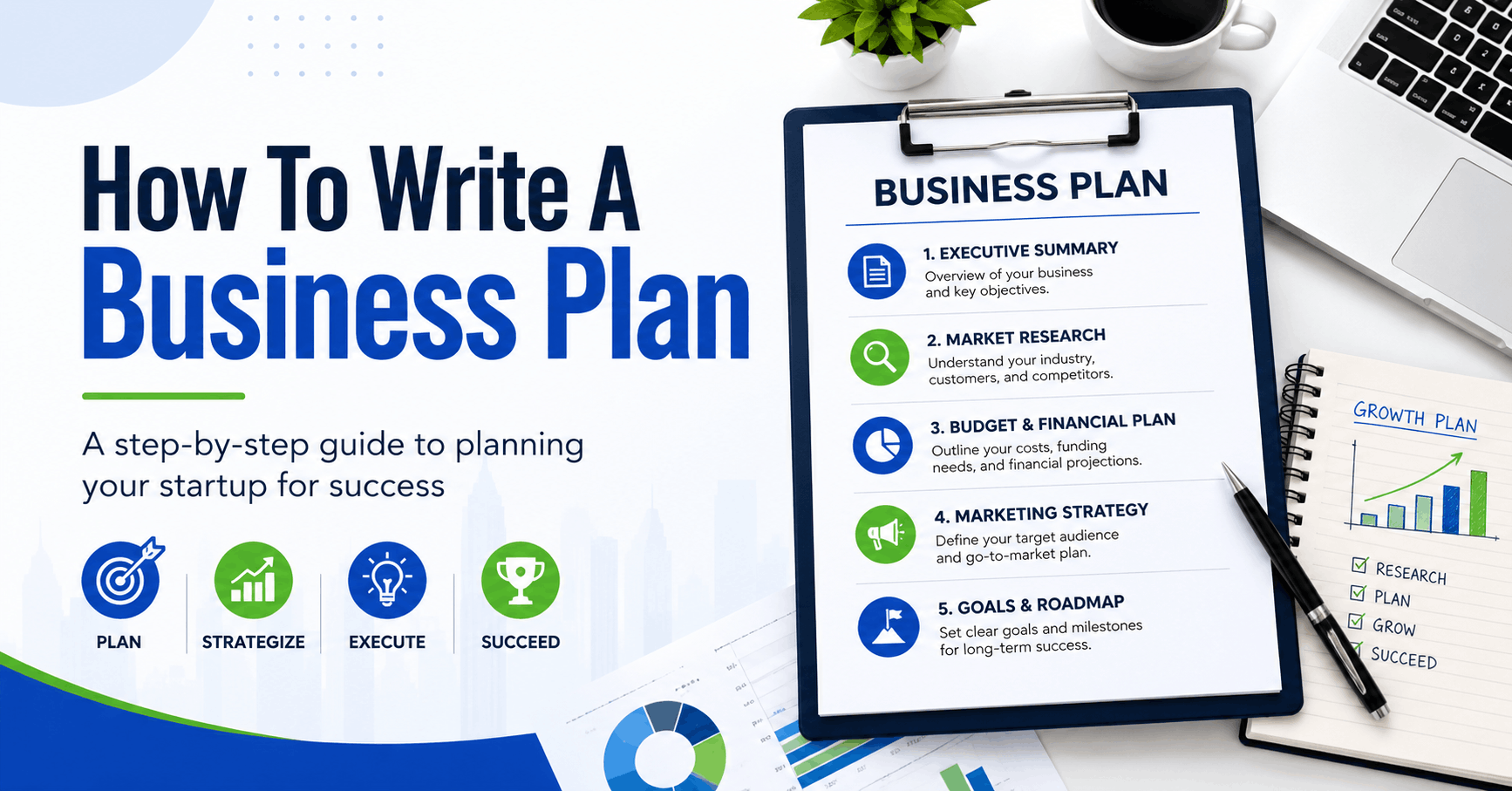
A business plan is the document that separates people who have a business idea from people who actually build one. It forces you to think through your market, your money, and your model before you spend a dollar. This guide walks you through every section of a solid business plan, in plain language, so you can write one that holds up under scrutiny.
What Is a Business Plan and Why Does It Still Matter?
A business plan is a written document that describes what your business does, who it serves, how it makes money, and where it's headed over the next one to five years. Banks require it before approving a business loan. Investors read it before writing a check. Accelerators ask for it during the application process.
Beyond funding, a business plan is useful for you. It's the document where contradictions in your model show up before they cost you money. The Small Business Administration reports that entrepreneurs who write formal business plans are 16% more likely to achieve viability than those who don't. That number isn't surprising to anyone who's tried to explain their unit economics out loud for the first time.
The plan doesn't have to be long. A focused 10 to 15-page document outperforms a bloated 40-page one almost every time. What matters is the quality of thinking behind each section, not the word count.
The Core Sections of a Business Plan
Most business plans follow a standard structure that lenders and investors expect to see. Deviating too far from it signals inexperience. Here's what belongs in every plan, and what each section actually needs to say.
Executive Summary
The executive summary is written last but placed first. It gives a one-to two-page overview of the entire plan: what the business does, who the customer is, what problem it solves, how it makes money, and what you're asking for (if you're seeking funding). Many investors read only this section before deciding whether to read further. Write it as if you have two minutes with someone who doesn't know your industry. Lead with the problem and your solution, not with the company history. Keep every sentence specific. "We help mid-size logistics firms cut route planning time by 30% using AI-assisted scheduling" is stronger than "We offer innovative software solutions for the transportation sector."
Company Description
This section tells the reader who you are as a business entity. Include your legal structure (LLC, corporation, sole proprietorship), the date you were founded or plan to launch, your location, and a clear statement of your business model. Describe what stage you're at: idea, pre-revenue, launched, or scaling. If you have existing customers, mention them here without disclosing confidential details. Investors want to know you're solving a real problem for real people, not building something nobody asked for. Two to three paragraphs is usually enough. Don't pad this section with mission statement language. Concrete facts carry more weight.
Market Analysis
The market analysis section is where most first-time plan writers either skip too fast or overcomplicate things. You need to show three things: the size of your market, who your target customer is, and who your competitors are.
For market size, use the TAM/SAM/SOM framework. TAM (Total Addressable Market) is the full global demand for what you sell. SAM (Serviceable Addressable Market) is the portion you can realistically reach given your geography and business model. SOM (Serviceable Obtainable Market) is what you can realistically capture in years one to three. According to IBISWorld and Statista, the most credible market size figures come from industry research reports, not back-of-envelope estimates. If you're citing a $50 billion market and going after 0.1% of it, show why that 0.1% is achievable, not just why it sounds small enough to be believable.
For competitors, list at least four to six direct and indirect alternatives your customer currently uses. Identify their pricing, positioning, and weaknesses. Then explain specifically why your approach wins against at least two of them.
Products and Services
Describe what you sell, how it works, and what it costs to deliver. For a product, explain the key features and how they map to specific customer problems. For a service, walk through what the client receives, how long it takes, and what's included. Include your pricing model here: per unit, subscription, project-based, or retainer. If you have intellectual property, patents, or proprietary processes, mention them. Don't oversell the product in this section. The goal isn't marketing copy; it's a clear, factual description that a stranger could read and understand without follow-up questions.
How to Write the Financial Section of a Business Plan
The financial section is the one most people dread writing, and the one investors spend the most time reading. You don't need an accounting degree to do it well, but you do need to be honest about your numbers.
Revenue Projections
Build your revenue projections from the bottom up, not the top down. Top-down projections ("We'll capture 1% of a $10 billion market") tell an investor nothing about how your business actually works. Bottom-up means you start with: how many customers can you realistically acquire in month one, what's your average order or contract value, how does that grow month over month, and what are the realistic constraints on growth (sales capacity, production limits, marketing budget)? Use a 12-month monthly model for year one, then switch to quarterly for years two and three. Microsoft Excel or Google Sheets works fine. You don't need specialist software.
Expense Forecast and Cash Flow
List every cost category: staffing, rent, software subscriptions, marketing spend, cost of goods sold, legal and accounting fees, and any loan repayments. Separate fixed costs (those that don't change with revenue) from variable costs (those that scale with output). The cash flow statement is different from the profit and loss statement. A business can show a profit on paper while running out of cash if invoices aren't collected on time. Show your monthly cash position for at least the first 12 months. If your cash balance goes negative at any point, explain how you'll cover it, whether through a credit line, investor funding, or deferred expenses.
The Operations and Management Section
This section answers a practical question every lender or investor has: who is actually running this business, and can they pull it off?
- Team overview: List the founders and key team members with a two to three-sentence background each. Focus on relevant experience, not titles. If someone on your team has done this before in another context, say so directly. That's the most persuasive thing you can put here.
- Operational workflow: Describe how the business operates day-to-day. For a product business, walk through sourcing, production, quality control, and fulfilment. For a service business, describe how client work is scoped, delivered, and signed off. Keep it short but specific.
- Key hires and gaps: Be upfront about who you still need to hire. Acknowledging a gap shows maturity. Pretending you have everything covered when you don't is a red flag for experienced readers. If you plan to hire a CFO once you hit $500K in revenue, say that.
- Advisors and partners: If you have a mentor with relevant industry experience, an accountant, or a legal advisor, include them. Advisory credibility transfers. A seasoned operator on your advisory board signals that people who've done this before believe in your model.
Getting this section right matters more than most people expect. A great idea with a weak team gets passed over constantly. Show that your team has done something hard before.
Common Mistakes People Make When Writing a Business Plan
Honestly, most of the problems in business plans aren't about missing sections. They're about the same few mistakes repeated across thousands of first drafts.
- Overstating the market opportunity: Claiming your TAM is $500 billion without explaining what fraction of that you're actually competing for tells the reader you haven't thought the model through. Investors know the full market size. What they want to see is your slice and your path to it. Use credible third-party sources like IBISWorld, Gartner, or government census data to back your numbers.
- Ignoring competition: Writing "we have no direct competitors" is one of the fastest ways to lose credibility in a pitch. Every product competes with something, even if it's the customer's current habit or a spreadsheet. Acknowledge your real competitors, and explain clearly why your offering wins on at least two specific dimensions.
- Financial projections with no basis: Revenue figures that jump from $50K in month one to $2M by month twelve without any explanation of how that growth happens won't survive scrutiny. Every spike in your projections needs a corresponding assumption: a new channel, a hired sales rep, a partnership. Walk an investor through the logic, not just the numbers.
If you're not sure whether your plan holds together, hand it to someone who doesn't know your industry and ask them to poke holes in it. The questions they ask are the same ones a bank officer or investor will ask. Better to hear them before the meeting than during it. You can also review our guide to common startup financial mistakes to catch errors before they cost you.
How Long Should a Business Plan Be?
| Plan Type | Typical Length | Best Used For |
|---|---|---|
| Lean/One-page plan | 1 to 2 pages | Early-stage internal planning, lean startup validation |
| Standard business plan | 10 to 20 pages | Bank loans, SBA applications, angel investors |
| Investor deck (pitch deck) | 10 to 15 slides | VC meetings, accelerator applications |
| Full business plan | 25 to 40 pages | Large SBA loans, franchise applications, and formal partnerships |
For most small business loans and early-stage investor conversations, a 10 to 15-page plan with a clean financial model attached is enough. Longer doesn't mean stronger.
Conclusion
Writing a business plan is the process of testing your idea on paper before you test it in the market. Work through each section honestly, build your financials from real assumptions, and don't treat it as a one-time document. Your plan should change as your business does. If you're seeking funding or a loan, consider working with a qualified accountant or business advisor to review your financials before you submit. Read our business startup checklist as a practical next step once your plan is complete.
Frequently Asked Questions
Q: How long does it take to write a business plan?
For most people, writing a solid 10 to 15-page business plan takes between one and three weeks, depending on how much research you need to do. The financial section usually takes the longest, especially if you're building your projections from scratch. Don't rush it. A plan you've thought through carefully will hold up better in a funding conversation than one you put together in a weekend.
Q: Do I need a business plan if I'm not seeking funding?
Yes, and many experienced entrepreneurs argue it's more useful in that context. Without the pressure of a funding deadline, you can write a plan purely to stress-test your own assumptions. It helps you spot cash flow gaps, clarify your customer, and set realistic growth targets before you've spent money finding out the hard way. A lean one-page plan works fine if a full document feels like overkill.
Q: What's the difference between a business plan and a pitch deck?
A pitch deck is a visual presentation, usually 10 to 15 slides, designed to walk an investor through your business in a meeting. A business plan is a written document with more detail, used for loan applications, due diligence, or internal planning. Most startup fundraising processes require both: a deck for the first conversation and a full plan for the diligence stage. They cover the same topics but in very different formats.
Q: Can I write a business plan without a financial background?
You can, but you'll need to invest some time learning the basics. You don't need to understand complex accounting, but you do need to be comfortable building a 12-month cash flow model and a profit and loss projection. There are free templates from SCORE, the SBA, and Bplans that give you the structure. If your numbers are significant or you're applying for a loan above $100K, it's worth having an accountant review the financial section before you submit.
Q: How often should I update my business plan?
Review it at least once a year, and update it any time something material changes: a new product line, a pivot in your target market, a major new competitor, or a significant shift in your cost structure. Banks and investors also expect to see an updated plan if you're returning for additional funding. Treating it as a living document rather than a filing cabinet item is what separates businesses that use it from those that just wrote it.
About The Author
System Admin is a veteran contributor to our journal, focusing on deep analysis and factual storytelling across multiple domains.
View all posts by this author